
Footpaths had been to Gilmore Ponds in the fall of 2024. At that time we noted a number of nests that made up a rookery, all large, but clearly of two different sizes. We planned to return during the nesting season to enjoy the spectacle. We thought that the large nests were from Great Blue Herons, but were unsure who had used the somewhat smaller nests.
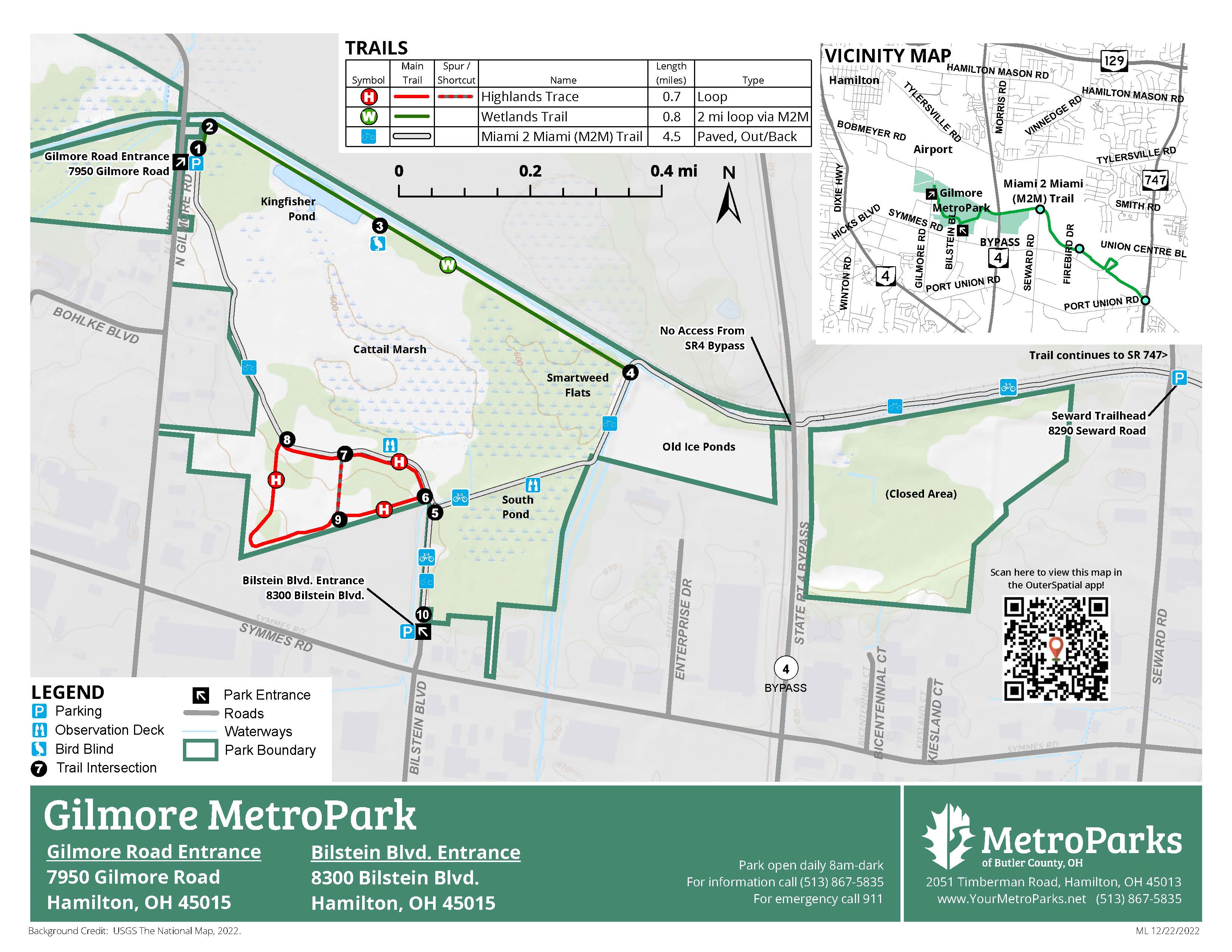
The map below will help orient the reader to the Metropark. We parked at the Gilmore Road Entrance, on the left upper corner of the map, and headed onto the Wetlands Trail. The rookery is in the area labeled Smartweed Flats.

The trail opens on a narrow boardwalk.

Once on the boardwalk, it became clear that the habitat was quite different in mid-May than it was in late October. Although the spring to this point had been unseasonably low in precipitation, we noted standing water in the woodlands that were dry on our last visit.


The boardwalk delivers one to a gravel and grass path that seems bound in by hedgerows. In reality there is a raised railway to the left and a series of ponds to the right.

Breaks in the thicket gives the visitor views onto the wetlands.


In one of these openings we sighted our first Tree Swallows across the water. We enjoyed watching the swallows perform their acrobatics as they fed on flying insects.

The hedgerow itself was stimulating as we noted several interesting species. Elderberry was frequently noted and was just beginning to flower.

In addition we noted Ragwort and Dame’s Rocket.


The photographer captured this pollinator visiting the Dame’s Rocket. It is a Margined Calligrapher, a member of the Hoverfly Family. They are considered beneficial insects. While the adults feed on flower pollen, the larvae feed on soft bodied insects that are detrimental to plants, like aphids and thrips. The adults resemble wasps, but are harmless. The mimicry reduces their risk of predation.

Our Merlin App was busy identifying the numerous bird songs that we were hearing. One just above us was a male Baltimore Oriole. They are migrants, spending their springs and summers breeding in eastern and central North America, and their winters in Florida, the Caribbean, Central America, and northern South America. The female does not have the male’s coloration and I need to do a better job identifying them. Male orioles are very involved in the protection and feeding of their offspring and their bright color may help you locate a nest.


Two types of mulberry were noted alongside the trail in the brush. Red Mulberry is a small native tree with red berries. The berries actually turn a reddish purple when ripe.

The White Mulberry, with white fruit, was brought to the States from Asia in the colonial period as part of an effort to establish a domestic silk industry. The leaves of White Mulberry are the primary food source of the Silk Worm. The domestic silk industry failed but the White Mulberry thrived to the point of becoming invasive.

When there is no fruit on the trees they can be identified by their leaves. The Red Mulberry leaf is coarse on its top and hairy on the underside. The White Mulberry leaf is smooth and shiny on top and hairless underneath.
As the trail opened onto Smartweed Flats, as labeled on the earlier map, we had unobstructed views across the pond onto trees with numerous nests of sticks, as noted in the title photo and below.


The majority of the nests, the somewhat smaller ones, were those of Double Crested Cormorants, but we also noted some Great Blue Herons and Great Egrets. The white of the Egrets can be seen in the lower right of second photo below.


With the aid of binoculars and a telephoto lens we could better appreciate the rookery and its inhabitants.


It was interesting seeing the different species nesting in such close proximity. The concentration of nests allows for better protection from predators, such as eagles and raccoons, with more eyes watching for danger. In the photo below we have a sleeping Great Blue Heron, with its head tucked in, as well as a Double-crested Cormorant.

After completing the Wetland Trail we turned right and headed clockwise through the remainder of the park on a segment of the paved, multi-use, Miami to Miami (“M2M”)Trail. This is a partially completed trail that will eventually total fifty miles, allowing users to travel from the Great Miami River to the Little Miami River, across the northern suburbs of Cincinnati.

Episodically overlooks onto other wetlands were offered.


Odds and Ends –
I previously mentioned the Tree Swallows that were quite active over the ponds. As we studied the rookery we noted one in a tree cavity in a nearby snag, while its partner was perched atop the dead tree.


Tree Swallows in flight can be differentiated from Barn Swallows by their lack of a deeply forked tail.

We did see a Barn Swallow a little later in the hike. You can appreciate his forked tail.

It was merrily singing.

At two different locations we got to observe Green Herons.

The photographer enjoyed the challenge of trying to capture this Song Sparrow that had positioned itself within the skeleton of last year’s Teasel. It was not till we reviewed the photos that we noted that he had a rather large insect in its beak.

Damselflies usually hold their wings up above their body when resting. That is not the case with Spreadwing Damselflies, who hold them at a V-shaped angle, “spread out” so to speak. Dragonflies hold their wings horizontally.

Lastly we noted White Water Crowfoot on some of the ponds. It is in the Buttercup family and plays two important roles in wetlands. It is an oxygenator, releasing oxygen into the water during photosynthesis, which helps keep the water clear and balanced. It also acts as a nursery plant, providing shelter for small fish and invertebrates. It is a native and found across North America as well as Europe. Some sources recommend it for water gardens but others note that it is toxic and can cause a rash.


In summary, our return outing to Gilmore Ponds was a success, allowing us to enjoy the bustle of the rookery that we had seen in the off season last visit. Our mid-May visit was perhaps a little late in the season as we did not appreciate the cacophony of bird calls that others have described when they had been to the rookery earlier this season. I might suggest that if one is interested in observing a large mixed rookery, that you put a note in your calendar for a visit during mid to late April. But Gilmore Ponds is really more than just the rookery, as attested by the number of folks enjoying the non-rookery part of the park. For birders, it is considered a birding hotspot by Audubon Ohio, with 253 bird species having been identified there.
Footpathsblog.com posts are released every Sunday morning and some bonus content is added periodically. Please click on a social media icon above to follow for future posts and to make sure that you catch all our reflections on, and adventures with, the great outdoors.
Photo credits to Peggy Juengling Burns.
Overview:
Location – 7950 North Gilmore Road, 21 miles from downtown Cincinnati. Make sure that you include the “North” as the park website map lists the address as 7950 Gilmore Road which takes you to a location on the wrong side of the railroad tracks that does not get you to the park.
Parking – there are two parking areas. The North Gilmore lot is asphalt and for about 20 cars.
Facilities – Portalet at the trailhead.
Trail Conditions – composite boardwalk, bare dirt/gravel/grass, and asphalt over the course of our walk. The M2M segment is an excellent multi-use trail and can be accessed from both parking areas. It allows for views on the rookery from different directions. It would need to be considered an out and back trail.
Print Trail Map Link – https://www.yourmetroparks.net/images/default-source/about/gilmore-trail-map5834a3d2-7ad2-43f4-8c5e-3002ea08d4f4.jpg?sfvrsn=476a4fea_1
Benches – one noted over our 2+ mile walk.
Picnic Tables – several noted at the trailhead.
Kids – Kids 4 and over will do well on the trail. The asphalt section of the M2M trails would be suitable for kids of all ages and is an excellent place to take a stroller or kids on bikes.
Dogs – welcomed on a leash.
Paired Hiking Trails – the 4.5 Miami to Miami multi-use trail is in good shape and could be a great walk on wet days when other trails could be muddy. It would have to be walked as an out and back trail, which if done in its entirety would be 9 miles.
Links:
https://www.yourmetroparks.net/parks/gilmore-metropark
https://footpathsblog.com/2024/11/10/gilmore-ponds-metropark-hamilton-ohio/