
Gilmore Ponds first came to my attention about thirty years ago, in the days before an easy internet search. I don’t recall my exact source but the promise of wetlands and migratory waterfowl always appealed to me. Unfortunately, I never got a chance to get there – until now.
Recently I was researching the Butler County Metroparks, looking for sites that might offer fall color, and I was reintroduced to Gilmore Ponds – not necessarily as a site for fall color, but I’m a still a sucker for a wetland.
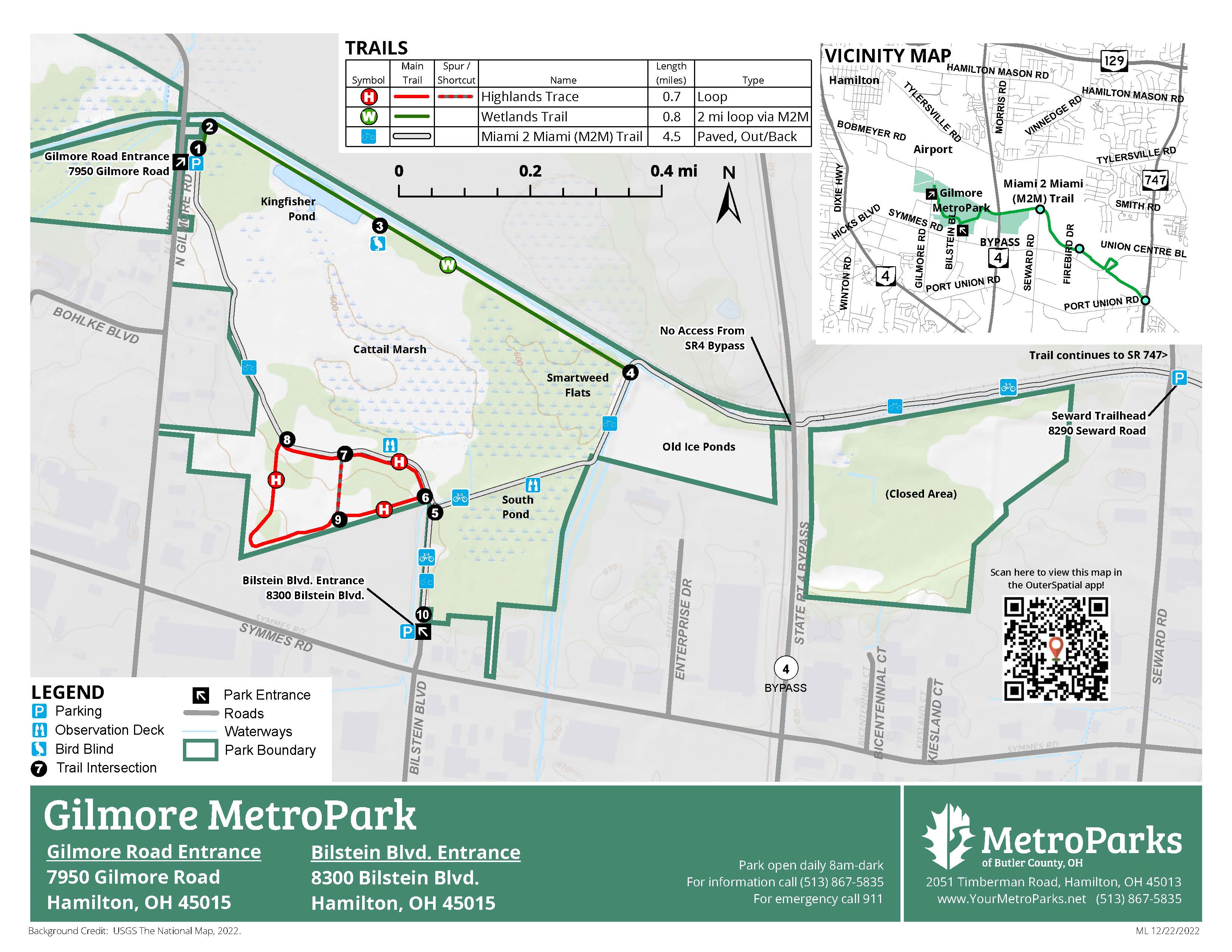
We parked at the North Gilmore Road parking lot and headed onto the Wetlands Trail.

It initially entered a wetland wood on a boardwalk before transitioning to a wide trail atop a utility right of way.


This route offered us views onto wooded wetlands and Kingfisher Pond; both demonstrated markedly low water levels due to the drought.


Just past the pond we found this massive elevated bird blind.

It was the cadillac of bird blinds, offering numerous viewing portals as well as some bird identification guidance for beginning birders.


It had views onto a variety of birding habitats including a woodland, a meadow, and Kingfisher Pond. If one plans to utilize the blind I would recommend that you consider taking a chair and staying awhile.

We r eturned to the Wetlands Trail and soon came upon this view. We were looking across a wetland meadow at a cluster of trees that hosted a number of nests – a rookery.

The nests consisted of small sticks, but varied in size. A friend who has birded at Gilmore Ponds told me that this rookery is used by many species including Common Egret, Great Egret, Great Blue Heron, and Double-crested Cormorants. She has seen a Great Horned Owl using a nest here as well.

As we studied the nests we noted that one was occupied by a trespasser – our second sighting of a Bald Eagle this fall.

Soon the Wetland Trail met up with the paved Miami 2 Miami (M2M) Trail. This 4.5 mile segment is part of the 50 mile connector trail that is being built to link the multi-use Great Miami River Trail to the Little Miami River Trail through the northern suburbs of Cincinnati. Form this trail we had the view captured in the title photo of the extensive Smartweed Flats noted on the map. On the other side of the trail we found a remnant of the Miami Erie Canal still holding water.

The M2M trail stood atop what would have been a tow path for the canal.

Soon we came upon one of the Cattail Marsh Overlooks, designed to give you views upon the wetland. Below is the first structure.

What we found however was exposed dry lake bottom. It was testament to the severity of our drought of 2024.

Returning to the paved path we found ourselves flanked in by colorful shrubs and small trees.

Study of these thickets demonstrated the effects that invasive species can have on native plants. Here an invasive Bush Honeysuckle, with green leaves, is growing over a native Gray Dogwood, with dark red leaves.

The honeysuckle still harbors its berries that will become last choice fodder for birds in the winter.

The Gray Dogwood berries, on the other hand, had already been consumed, as noted by the barren panicles.

Around the bend we came upon the second Cattail Marsh Overlook. This was the larger of the two.

The view at this time was of marshland devoid water.

Nearby the trail ended at the parking area.
The outing was not without color, although it was on a small scale. I frequently remark on the beautiful fall color of poison ivy and we found a couple of examples of it along this walk. The first is in its ground cover form and the second as a vine.


Fall color was also noted in the groupings of small Cottonwood trees along the path. Cottonwoods are a wetland species so it is not surprising to find them here.

We also found an assortment of late season wildflowers including Indian Blanket, whcih we saw at a couple of locations. I think it was the first time that we have seen it in the wild since a visit to the Badlands of South Dakota.


There was also this colorful New England Aster with many flowers just beginning to open.

Lastly, we saw Cutleaf Teasel, which is a non-native. It differs from Common Teasel in that the bracts that surround its flowerhead at more horizontal rather than arching. Unfortunately it is increasingly being recognized as “invasive”.

Gilmore Ponds is a noted birding area and we several birders working their way along the trails. This Field Sparrow cooperated for a photo.

Other wildlife seen included this Metric Paper Wasp which was collecting nectar from a Goldenrod. It is one of few species of wasps that makes honey, which is the primary food source for its larvae. They will also prey on soft-bodied insects and caterpillar larvae. They build nests similar to the Yellowjacket nests frequently found on the eaves of houses.

The interesting find of the day was this, which I saw on the ground as we approached one of the overlooks. It had a unique surface and did not recall seeing one before. Research told me that it is the hard structure that holds the hundreds of winged seeds that make up a Sycamore seed ball. So while I have touched numerous Sycamore seed balls, I had never handled the small hard structure inside that the seeds are attached to until they take flight.

Here you can see one still on its stalk near two intact Sycamore seed balls.

Another surprise that we had was when we saw a sign for a fundraising campaign for replacing the boardwalk that included the image from this poster by Charley Harper, perhaps our favorite wildlife artist. His playful designs and bold colors bring a sense of fun and whimsy to nature. The poster was originally released in 1998. Charley passed away in 2007.

In summary, it was exciting to finally get to Gilmore Ponds, and even more so now that I know that Charley Harper saw the value of this place. While the wetland was a little parched due to significant drought, it was easy to see the potential the park has for wildlife viewing. A MetroParks staff member has recommended a spring time visit when “the wetlands come alive and the rookery is teaming with activity”. I will put a spring time visit on the Footpaths itinerary and perhaps we can do a “focused topics” article on rookeries.
Footpathsblog.com posts are released every Sunday morning and some bonus content is added periodically. Please click on a social media icon above to follow for future posts and to make sure that you catch all our reflections on, and adventures with, the great outdoors.
Photo credits to Peggy Juengling Burns.
Overview:
Location – 7950 North Gilmore Road, 21 miles from downtown Cincinnati. Make sure that you include the “North” as the park website map lists the address as 7950 Gilmore Road which takes you to a location on the wrong side of railroad tracks that does not get you to the park.
Parking – there are two parking areas. The North Gilmore lot is asphalt and for about 20 cars.
Facilities – Portalet at the trailhead.
Trail Conditions – plastic boardwalk, bare dirt/gravel, and asphalt over the course of our walk.
Print Trail Map Link – https://www.yourmetroparks.net/images/default-source/about/gilmore-trail-map5834a3d2-7ad2-43f4-8c5e-3002ea08d4f4.jpg?sfvrsn=476a4fea_1
Benches – one noted over our 2+ mile walk.
Picnic Tables – several noted at the trailhead.
Kids – Kids 4 and over will do well on the trail.
Dogs – welcomed on a leash.
Paired Hiking Trails – the 4.5 Miami to Miami multi-use trail is in great shape and could be a great walk on wet days when other trails could be muddy. It would have to be walked as an out and back trail, which if done in its entirety would be 9 miles.
Links: