
It was the proverbial ” looking for a needle in a haystack” – trying to find a Great Blue Heron rookery in the 335 acre Glenwood Gardens Park. I had communicated with a naturalist from the Great Parks of Hamilton County about not being able to find the reported rookery at Winton Woods Park on our outing the previous week. She assured me that while the one at Winton Woods was no longer active, there was one that could be seen from the Wetland Trail at Glenwood Gardens. I was told that I would find them “where the service road met up with the Wetland Trail”. The service road does not appear on the trail map however.
This park is a favorite of ours – it marries many of our interests: botanical garden, arboretum, and hiking, so we were happy to return. The walk starts formal – in a manicured botanical garden. Just inside the entry you are greeted by a scarlet ornamental Honeysuckle climbing the overlook trellis.


The overlook gives an expansive view onto the Garden Loop Trail and a meadow below.

Other lovely flowers that we saw in the botanical garden included a collection of Irises,

as well as swathes of the perennial, Bigroot Geranium.


As one leaves the botanical garden, the trail begins to transition from formal to informal, and heads downhill onto the paved Garden Loop Trail.


The lower bowl is where the arboretum is, bordering on the unmowed meadows.

Amongst the specimens was this Fringetree, which is native to the American Southeast.

It is one of the last trees to leaf out in the spring and it goes by the nickname of “Old Man’s Beard”.

Also putting on a display was this Korean Dogwood. Korean Dogwoods bloom after the leaves are already on the tree, whereas our native dogwoods flower first, then leaf out.

The flower petal of the Korean Dogwood is also more angular, whereas our native dogwood’s petals are rounded.

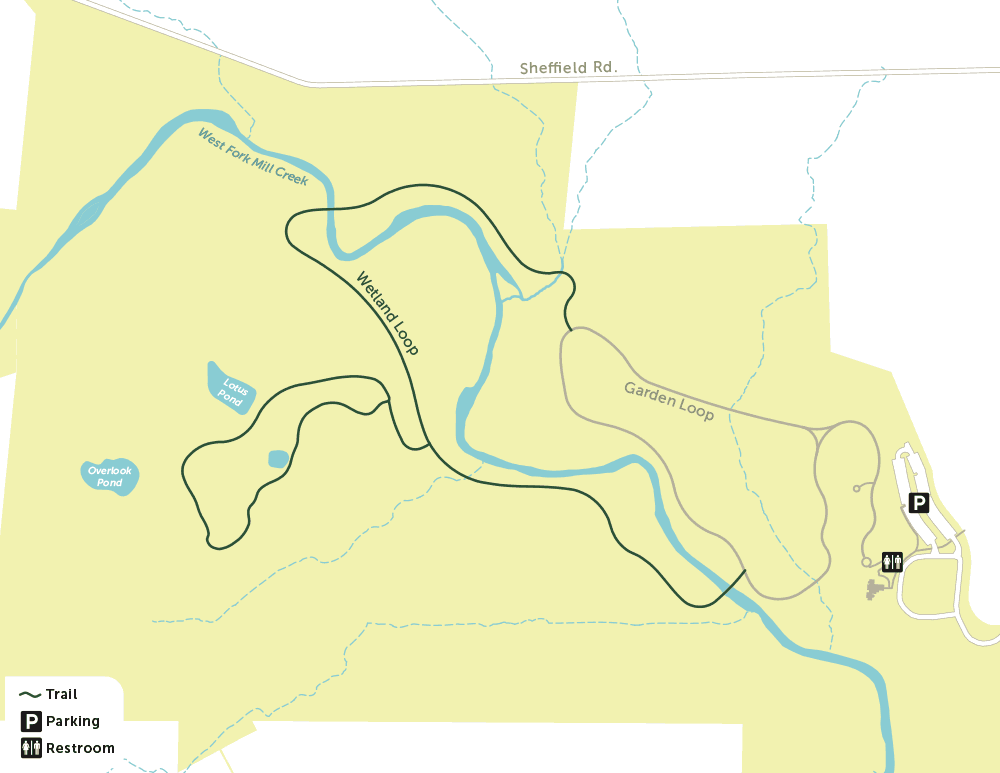
As the photographer and I meandered clockwise around the Garden Loop Trail, searching the full tree canopy along the West Fork of Mill Creek for heron nests, I lost confidence that the rookery would be easily found. We crossed a small bridge and found another photographer, Don, taking macro images of insects in the plants along the path. When we asked if he knew where the heron rookery was, he commented that perhaps “rookery” was too grand a term, as he was pretty sure that there was only one nest. He eagerly insisted on leading us to the nest, as he was sure that we would not find it on our own. We continued clockwise on the Garden Loop Trail, until we exited left onto the Wetland Loop Trail.

We walked the half mile or so at a quick pace as the sky was somewhat threatening. He then took us on an unofficial side trail that led to the bank of the West Fork of Mill Creek. This trail location is noted in red on the above map and arises from the Wetland Trail between a portolet and the 0.2 mile marker.


On the opposite bank, high in a Sycamore tree was the nest, with two young, but quite large, heron chicks. The chicks already appeared to be two feet tall.

The nest was less structured and substantial than the nests of Bald Eagles and hawks that we have observed.

After observing the heron chicks for some time, Don returned to his insect endeavors and we continued on the Wetland Loop, crossing the Mill Creek on a substantial bridge, hoping to spot additional nests from the other side of the creek.

From the bridge we enjoyed views onto the creek itself,


and noted this large Smooth Softshell Turtle.

The 28 mile Mill Creek is an environmental success story, having transitioned from a polluted open sewer for most of the 20th century, to a waterway teeming with wildlife and now acting as a wildlife corridor in much of western Hamilton County, Ohio.
As we worked our way counter-clockwise on the Wetland Trail we did not observe any additional heron nests, but did see some nice wildflowers.
Fleabane and Golden Alexanders


Purple Phacelia and Blackberry


On the edge of a large wet meadow we noted clumps of False Indigo, with its vibrant purple flowers.


In several locations we saw this interesting plant – its stem was ribbed like corduroy. My research identifies it as Wild Parsnip, a somewhat invasive species from Eurasia. Its leaves offer a unique toxicity – juice from the leaves can cause severe burns and blistering of the skin when exposed to sunlight. Like culinary parsnips, the root is edible.

No wetland and meadow hike would be complete without a photo of a dragonfly – in this case an Eastern Pondhawk. Our new photographer friend and guide to the heron nest, Don, an insect enthusiast, would have enjoyed this.

Crossing the Mill Creek for the final time, we came upon this Broadhead Skink. The red coloration of its head tells us that it is a male.

I kept my distance to allow the photographer to get her shots. Interestingly, as I approached him, he decided to get friendly, climbing up on my boot. Notice the ear hole on the side of his head.


My new nickname is “The Skink Whisperer”.
In summary, our outing was a success in that we did get to see an active Great Blue Heron nest. It was not the collections of nests that we expected in a rookery but it was neat to watch the chicks, especially when they sensed their mother was nearby. It was also fun to meet a fellow nature photographer and share our excitement as we discussed some of the outstanding preserves that we have in our region. He gave us a couple of new places to add to our list. Finally, I always get energized when I see people out enjoying nature. Glenwood Gardens is well utilized but big enough that it never seems crowded.
Footpathsblog.com posts are released every Sunday morning and some bonus content is added periodically. Please click on a social media icon above to follow for future posts and to make sure that you catch all our reflections on, and adventures with, the great outdoors.
Photo credits to Peggy Juengling Burns.
Overview:
Location – 10397 Springfield Pike, Wyoming, Ohio, 15 miles from downtown Cincinnati, just a couple miles off I-75.
Parking – Large landscaped asphalt lot adjacent to the formal gardens.
Print Trail Map Link – https://res.cloudinary.com/govimg/image/upload/v1615483891/5a5f7a6b41a5361ef1395dbc/GG-Wetland-Loop.gif
Facilities – Heated restrooms in the gatehouse entry to the gardens and a porto-let on the Garden Trail.
Trail Conditions – The Garden Trail is asphalt and the Wetland Trail is well maintained gravel. Arising off the Wetland Trail is the trail to the ponds which is grassed. Other than the grade into and out of the valley these would be classified as easy trails.
Benches – Numerous throughout the facility.
Kids – Kids would do well here.
Dogs – Welcomed while on leash of 6 feet or less. Numerous dogs were seen on our visit.
Links:
Very cool pictures of the skink.
Thanks. Funny how that situation unfolded.
PHOTOS GREAT AS USUAL MADE MY VISIT TO YOUR SITE EVEN BETTER THAN YOU DESCRIBE