
The weather did not dictate the use of this paved path. Rather, a hope to visualize the Great Blue Heron rookery that was mentioned in the description of this multi-use trail on the Great Parks of Hamilton County website did. It is prime nesting season for herons so we anticipated some exciting activity.
Characteristic of the Great Parks, the trail started at an educational site – demonstrating through plantings and signage how rain gardens, both at public and private places, can benefit the environment by handling storm water and filtering pollutants before they enter our waterways. Rain gardens are depressions in the terrain, planted with native plants, that capture rain water off of paved surfaces or roofs, and filter the water before it makes its way to the water table or streams. I have provided a link to an instructional website at the end of this article about how to create a rain garden.


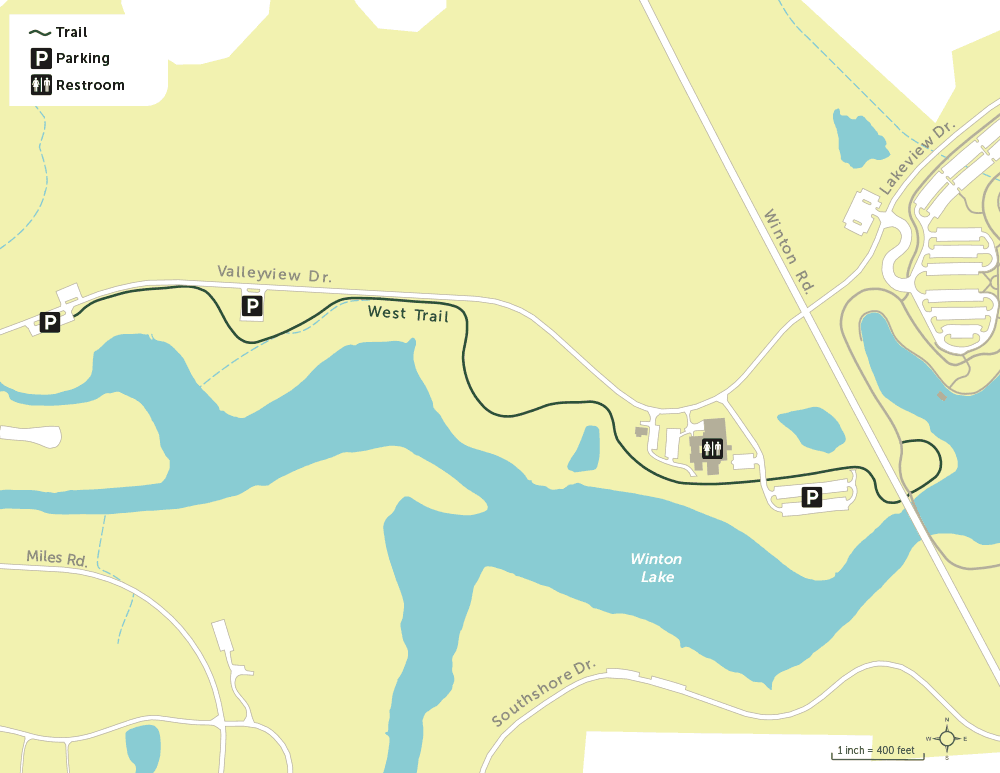
We walked the gentle grade keeping our eyes peeled for the occasional views of Winton Lake that we could see through the trees to our left. Winton Lake was created by the Army Corps of Engineers in 1952 by the damming of the 28 mile Mill Creek, a tributary of the Ohio River, as a response to the devastating 1937 Ohio River flood.

Early during the walk we took a diversion that led down to a small pond or backwater of the lake, as seen in the title photo and below.

There we were coarsely serenaded by noisy male Red-wing Blackbirds. The males are dressed with bands of red and yellow on their wings. Females are less vocal, smaller, and have a medium brown body and mottled chest, looking like a large sparrow.

Here we also saw some large Red-eared Slider turtles sunning themselves on a log in the middle of the pond.

After those sightings the hike became a study on the spring flowering of lesser appreciated trees and plants. We know that these plants form fruit or seeds, but frequently fail to recognize the flowering structures – sometimes because they are non-descript, but other times perhaps, because they are high above our line of vision or not in the areas we frequent.
The first of these were botanical cousins, Blackberry and Raspberry. The flowers of Blackberry are larger and easily noted. The Raspberry can be identified by the reddish coloration to its cane.


This bit of chaos is the flower head for a Wild Grape. You can see the elongated stamens which will deposit pollen on visiting pollinators.

This can be better appreciated on a magnified view. In fact, the grape flower does not have true flower petals. What we are seeing is the bulbous female part of the flower, the pistal, and the filamentous male part of the flower that produces pollen, the stamens. The pistal has a little opening at its top. Bees access this opening to collect nectar, and by happenstance leave behind pollen from another flower that pollinates the pistal.

These clusters of fruit were seen on a Cottonwood tree. The flowers were present previously. They are not commonly appreciated because they are usually held well above our heads on mature trees. This base of this tree was downhill from the trail and this branch had drooped to near eye level.

In late spring these capsules will open to release their seeds, which have attached cotton-like fibers that allow the seeds to float on the breeze to travel good distances from the parent tree. Hence the name, “Cottonwood”.


The Sycamore fruit is a ping pong size seed cluster. It flowers however are pea size. Sycamores are monoecious, meaning individual trees have both male and female flowers on the same plant. Given the red coloration and the long stem this appears to be a female flower. The male flower is a little smaller, has a short stem, and is greenish-yellow in color.

Black Walnut is another tree with non-descript flowers, which appear about the same time that the tree is starting to leaf out.

Initially, I was confused by the long chains of flowers, a raceme, when Black Walnuts typically only have isolated nuts or in clusters of two. My error? – These long chains of flowers are the male, pollen producing flowers. The small female flowers are less conspicuous, occur in groups of two, and are located at the tips of the branches in the cluster of compound leaves that attach there – a good location when you are wind pollinated.

The last tree that we will comment on is Black Locust. It has beautiful, bright white, pea family shaped flowers. The fact that they are pea-shaped is not surprising as locust are classified as legumes, as are peas, having seeds in pods The flowers are fragrant, giving off a citrus scent. They are pollinated by insects, especially bees, and Hummingbirds.

Also seen along the path were several late spring flowering plants.
Pink and white forms of Fleabane.


Swathes of Sweet Cicely were seen in the undergrowth of the young forested hillsides.

Golden Ragwort took up residence in spots of sunshine.

But the highlight of our outing happened when we revisited the small pond that we had stopped at earlier in our hike. We had taken a seat to just see what might stop by the wetland. We then saw this mother Wood Duck lead her brood of twelve down the hillside on the opposite bank and enter the pond – perhaps their first swim. Wood Ducks are one of the few species of ducks that will nest in tree cavities, some as high as 60 feet off the ground. The female lays one egg a day until her clutch is completed. She delays incubation of the eggs until the last one is laid, insuring that they all hatch at the same time. The day after hatching the ducklings will leap to the ground, leaving the nest, never to return.

In summary, while our primary goal of seeing a heron rookery was not accomplished, it was a good outing – a chance to study some of the flowering plants and trees that we often take for granted. We have communicated with the park district about the location of the rookery and they have informed us that the herons have not nested there for a couple of years. They are in the process of removing that item from the website. The real bonus was seeing the little Wood Ducks dutifully following their mother.
Footpathsblog.com posts are released every Sunday morning and some bonus content is added periodically. Please click on a social media icon above to follow for future posts and to make sure that you catch all our reflections on, and adventures with, the great outdoors.
Photo credits to Peggy Juengling Burns.
Overview:
Location – 10245 Winton Road, Cincinnati, OH, 15 miles north of downtown Cincinnati.
Parking – large asphalt lot.
Facilities – Indoor restrooms at the ranger’s station near the trailhead.
Trail Conditions – paved. Gentle grade.
Print Trail Map Link – https://res.cloudinary.com/govimg/image/upload/v1615483893/5a5f7a6b41a5361ef1395dbc/WW-West-Trail.gif
Benches – Several noted.
Picnic Tables – numerous throughout the park.
Kids – Kids of all ages should do well.
Dogs – Welcomed on a 6 foot leash.
Paired Hiking Trails – There are 5 other trails at Winton Woods, ranging from 0.15 mile to 1.1 mile.
Links:
https://www.greatparks.org/parks/winton-woods
Here is the link to the “how to” article on rain gardens.
https://www.greatparks.org/discovery/conservation/rain-garden
I’ve just recently planted 5 types of these ephemerals on my property including the wood poppy. Thanks so much for your blog. Just lovely. But esp. heartening.
I love that word – heartening. It is a much appreciated compliment and really gets to what we hope to do at Footpaths – to give peace in these hurried and anxious times.