
I first heard about Salamander Run Metropark when it was featured on our local NPR affiliate, WVXU. It was newsworthy because the preserve was developed near the former site of the Fernald Uranium Processing Plant which had to undergo extensive environmental remediation due to radioactive contamination.
Fernald was a product of the Cold War. After WWII, U. S. military leadership was looking to centralize the production of uranium for nuclear weapons. Starting in 1951, they moved operations that were taking place at several locations across the country to Fernald, Ohio, where the campus eventually totaled 1050 acres. Over the years 7000 workers had been employed there. The facility closed in 1989 due to the end of the Cold War and the uncovering several years earlier of toxic emissions into the community. The heaviest contamination was at the processing plants and the waste pits, but there was more widespread radioactive deposition through atmospheric dust release and wind dispersal. The ground and surface water was contaminated. In 1989 Fernald was listed as a Superfund site and remediation was begun. The 1980 Superfund Law prioritized sites for long-term cleanup due to the risks they pose to human health and the environment. The intense Superfund remediation was certified complete in 2007. That same year the 1050 acre campus opened to the public as the Fernald Nature Preserve.
Beginning in 2010, a supplemental, long-term restoration program began. With funds from a State of Ohio settlement with the federal government related to the contamination, two local organizations acquired land and conservation easements on properties outside the Fernald campus to provide additional protection to the watershed of the region. The clean water from these lands helps flush the remaining uranium in the ground water to extraction wells where it is removed. To date over 16,000 pounds of uranium has been removed. These acquisitions allowed greenspaces to remain wild, farmland to remain farmland, and for some habitat improvement projects, helping nature to heal herself. The active removal, the stoppage of additional uranium releases, and time have resulted in marked improvement in levels of contamination in both the surrounding communities and the ground water.
One small step in that process was Butler County taking on the management of the 125 acre Salamander Run Nature Preserve, one of the habitat improvement sites, which opened in 2021.
It was beautiful weather for a early fall hike . Our first impression was that the park was well maintained – spotless parking area, excellent signage, and recently mowed paths.

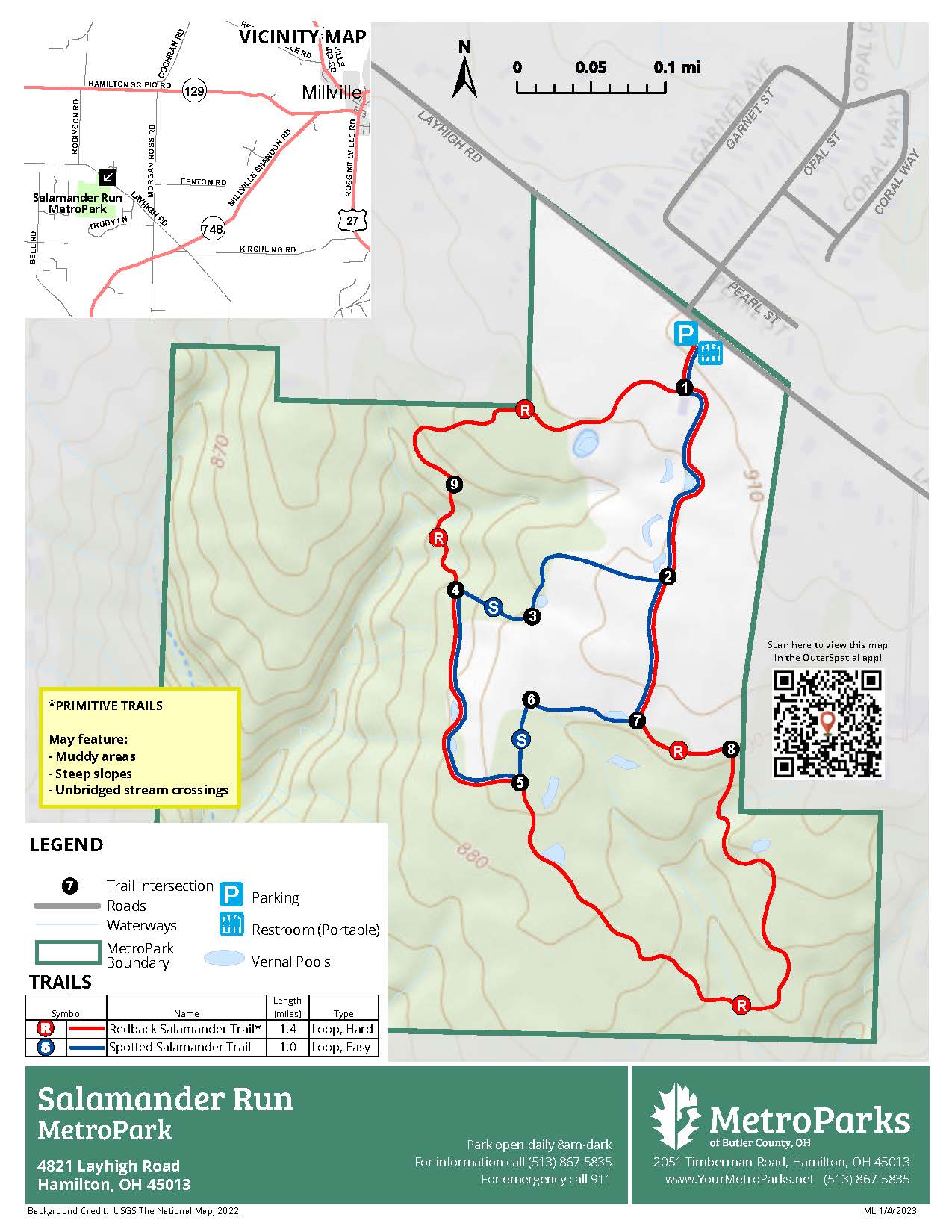
Our plan was to hike the Redback Salamander Trail which is red on the map below. The preserve website reported that the distant part of the trail, from intersection 5 to intersection 7, would be closed from September 25th, 2025 to February 3rd, 2026 due to the controlled bowhunting of deer, so we knew our hike would be cut short.

We walked the trail counter clockwise and almost immediately the path opened onto a late season meadow full of native plants. Since the hike I have learned that in the past these were soybean fields.

The stalwart wildflowers of fall were on display.
Frostweed Aster – its narrow leaves are almost lost amongst the abundant white flowers. Frostweed – really? For years I have called this Ghost Aster, but now I can not find any reference to that name. But since it flowers around Halloween and it is white, it does seem like the perfect name. Where do I send in my request for a name change?


New England Aster – there are 10 pink to purple asters in the region, which are often hard to differentiate, but I am confident that this is New England Aster due to the sheer number of petals on the flowers. All the others have 20 petals or less.

And of course Goldenrod, as seen in the title photo and below. There are 25 species of Goldenrod native to Ohio and I promised myself that my retirement would not be consumed by a need to identify them individually – a challenge for this compulsive identifier.


The pairing of New England Aster with Goldenrod always make for spectacular color contrast.

As we worked our way through the meadow we started to capture the first evidence of fall color change off in the distance.

About the same time we saw this majestic Sycamore ahead.

I was perplexed when I studied its branching structure – what process caused three small branches to join together to become one large branch? I have seen this type of structure before in ornamental gardens by grafting, but never in the wild. Did I mention that there was uranium contamination in the community? Just kidding …. I think.

The trail mainly wove along the edge of meadows, but we did pass through a mid-aged wood.


There is nothing that the photographer likes better than good trail signage and Salamander Run was on top of it. Each trail intersection was numbered, as noted on the map, and had clear directional signaling.

As we ventured past this intersection I glanced ahead and mentioned to the photographer of the outstanding fall color of the small Red Maple ahead. Also note the large leaf of Prairie Dock in the lower left corner.

But it was not a Red Maple – it was an outstanding small Sweetgum, something we don’t see in the natural landscape too often in our part of the Ohio River Valley.

One of the features of the property is the vernal ponds present in the meadows. Vernal ponds are small depressions that hold standing water in the late winter and spring, and are reproduction pools for amphibians such as frogs, toads, and yes, the salamanders that give the property its name. The best time to see these animals are on warm rainy nights in the spring with temperatures above 40 degrees. In early October the ponds were hard to capture with photography, but the local botany helped us identify them – plants that are common in wetlands. Buttonbush is a native plant that we have mentioned several times this year and is a pollinator favorite when flowering.


Mallow, which is our native Hibiscus, is another wetland plant. If we had been here 6 to 10 weeks ago these stems would have been topped with a saucer size, tropical appearing, white to light pink flowers, with a dark red eye. The clustered seeds in the Mallow pods in the second photo are fascinating and are a favorite of Goldfinches.


For wildlife, fall is the season of bounty, and at Salamander Run much was on display.
Nannyberry is one of our native Viburnums.

We saw two types of Dogwood shrubs on this hike. Due to the drought, the Silky Dogwood berries had become raisin-like.


The Grey Dogwood has berries that resemble doll eyes.

The walnuts at Salamander Run appeared to be quite large and Black Walnut was perhaps the most common tree of the meadow edge.

Rose hips are an under-appreciated nutrition source for wildlife and provide Vitamin C.


Another great food source for wildlife, especially birds, is Poison Ivy. Here we found it in a Wild Rose thicket. Typically they have a more white coloration. Birds will eat berries and then deposit the seeds in their feces in a fence row or at the base of a tree – ideal spots for a new vine to grow.

Ironweed seeds are eaten by Goldfinches, Sparrows, and Cardinals.


We found these Woodland Oats on the edge of the wood. The plant has multiple names depending on where it is found – Northern Sea Oats around the Great Lakes, Woodland Oats in a forest opening, or River Oats on the edge of a stream. But they are indeed the same species, Chasmanthium latifolium.

In addition to the botany, this short outing offered an abundance of fauna to study.
This beauty, on a Frostweed Aster, is a Spotted Cucumber Beetle. They are native and pretty, but are considered a major agricultural pest. The larvae feed on the roots of young corn plants, while the adults feed on the vegetation and flowers of many other food plants including Cucumbers.

This acrobat did impressive feats as it traveled from tree to tree. At the time I thought that it was a Fox Squirrel but when we saw this photo that was not the case. It is a Red Squirrel and we were at the southernmost edge of its native range. To be honest, I do not think that I ever identified one before – not because I had not seen one, but because I did not differentiate it from the two squirrels that I am more familiar with, the Fox Squirrel and Grey Squirrel.

The range map for the Red Squirrel.

As we watched these two birds we noted that their behavior and flight pattern was like that of a Goldfinch but did not recognize their coloration. Fall is the time of molting for Goldfinches and these are probably in a transition stage from the summer to winter plumage that we are more familiar with. The Merlin Bird ID app had the answer for us.

When we saw this butterfly we originally thought that it was a Pipevine Swallowtail. But as we got closer we noted that it was smaller than a swallowtail. It is a Red-spotted Purple, a subspecies of the White Admiral butterfly. Those born in the southern part of their range have developed an appearance that mimics the Pipevine Swallowtail, whose range it overlaps with. Pipevine Swallowtails are toxic to predators and this coloration mimicry lessens the Red-spotted Purple’s risk of being preyed upon. With tattered wings and clumsy flight, we suspected that it was at the end of its life. My boot is present for size comparison.

We always like to include trail photos to give the reader a sense of place. One section of trail wove through a small wood between two meadows on what appeared to be an old farm lane.

The final section of trail was a slight climb through the middle of a large meadow.

We came upon the final encounter of the day at the crest of this path, just before returning to the parking area. A lovely Honeybee on a New England Aster.

Lastly, it has been a while since we did a seek and find.

Did you see it?

A Fork-tailed Bush Katydid looked just like a Goldenrod leaf.

In summary, our outing to Salamander Run was a terrific success. It was one centered on science and observation rather than vistas or unique habitats. The rolling terrain makes this a good cardio workout amongst nature, and the section that was closed for a controlled bowhunt at the time of our visit appears to offer additional time in the woods. It is exciting to see that something that was considered an environmental hazard has been rehabilitated and now is a great space to experience the relaxation of the outdoors.
Footpathsblog.com posts are released every Sunday morning and some bonus content is added periodically. Please click on a social media icon above to follow for future posts and to make sure that you catch all our reflections on, and adventures with, the great outdoors.
Photo credits to Peggy Juengling Burns.
Overview:
Location – 4821 Layhigh Road, Hamilton, Ohio, 30 miles from downtown Cincinnati.
Parking – gravel lot for 8-10 cars.
Trail Conditions – generally mowed grass with bare dirt on the woodland stretches.
Print Map Link – https://www.yourmetroparks.net/images/default-source/about/salamander-run-trail-map.jpg?sfvrsn=9c614fea_1
Facilities – Portolet.
Benches – none noted.
Picnic Tables – none.
Kids – I would suggest 4 and over.
Dogs – welcomed on a leash.
Suggested Paired Hikes – none.
Craft Beer – Fretboard Brewing is in a rehabbed storefront in downtown Hamilton, just a few miles away.
Links:
https://www.yourmetroparks.net/parks/salamander-run-metropark