
Finding a prairie venue close to a major city is a challenge – luckily some have been re-established utilizing seeds from existing prairies. Such was the case with this prairie, which was planted in the 1970s before prairie restoration became fashionable.
This is marketed as a prairie trail but that is somewhat misleading as 2/3rds of the hike is spent in a mature wood – an excellent wood mind you. But to be honest, a shady, cool wood is a nice respite when hiking through prairies in late July and August.
As we entered the wood I was surprised. When I do educational programs I spend a lot of time stressing the ways to identify poison ivy, and emphasizing that it comes in three forms: a ground cover, a vine which most of us are familiar with, and less commonly, a shrub that can reach to 8 foot tall. At the start of this trail I identified all three forms in a stretch of twelve feet.
First was the ground cover form – about 6 to 8 inches off the ground. The tell-tale finding is the compound leaf with three leaflets, and the end leaflet having a longer petiole (stem). But this leaf shape is true for all three growth forms of Poison Ivy, making it easily identifiable.

The vining form had the same type of leaf, again circled in the photo below.

The least common form of poison ivy is the shrub, which can reach eight feet in height. Here they were about 4 – 5 foot tall, as can be seen behind me in the photo below. Again, the leaf had the same shape.

The wood itself was excellent with generally an open understory.

Nature tried to distract me by offering up some points of interest, especially fungi.
Oyster Mushrooms and a Weeping Widow.


But I was a on a mission – prairie bound. And then it happened – the trail opened onto our first view of the meadow.

Flowering forbs were in the foreground, letting us know that we had arrived:
St John’s Wort – herbalists use a compound of this plant for depression. It works in a similar mechanism to Prozac and Zoloft.

Heal-all – named such as it was used for many conditions in folk medicine.

I particularly like the contrast between this Slender Mountain Mint and the orange Touch-me-not in this photo. Touch-me-not is a native impatiens and the leaf is similar to garden impatiens.

From the entry we began to meander across the prairie. The meadow itself is appropriately small, as were most in this part of Ohio – perhaps 3 acres. It’s border is mowed, but the actual trail path bisects the meadow. We stole some extra time on the mowed border, just to make sure that we were not missing something special.
The amazing thing about prairie walks is the number of times that you see isolated specimens of species. Such was the case here where we saw this lone Hedge Bindweed, being visited by a bee,

as well as this Spiderwort. It was picture perfect and could be used for a museum specimen. The buds below the flower will soon reach up to bloom and there will be a small cluster of flowers.

These were the only specimens of those species that we saw that day.
As we worked our way along the trail we encountered many other flowering plants.
Gray-headed Coneflower and White False Indigo – the central eye for the coneflower starts as a greenish gray which gives it its name. As it ages it turns a rusty brown. The False Indigo started flowering in early June and was at the end of its season.


Bergamot, our native bee balm, and Stiff Goldenrod. The flower head of Stiff Goldenrod is much more compact than other Goldenrods.


Others included:
Rattlesnake Master

And a few isolated specimens of Black-eyed Susan.


Two plants that were particularly attractive to the butterflies were Liatris,


and Common Milkweed – this specimen is hosting three species of butterflies. We were viewing this activity from about 40 feet.

One of my favorite prairie plants is Compass Plant – perhaps it is because it towers above its peers, or due to its unusual flowers arrangement. It gets its name from the way the large basal leaves orient themselves in a north-south direction. It is thought that this orientation helps them retain moisture during drought.


The naturalist literature says that the prairie is the most diverse habitat in nature, both with regards to plants and insects. Perhaps we do not feature enough photos of the insects. The photographer did capture this “Robber Fly” sunning itself on a Dogwood leaf. These are predator flies, capturing other insects in mid-flight and feeding on them. They usually perch themself on the border of open terrain, such as a prairie, and look for their prey – exactly where we found this one.

One of the things that struck the photographer and I on this short meadow walk was the abundance of fruiting plants found along the margin of the meadow – again reflecting the diversity of the ecosystem.
Black Berries, which always ripen in late July, and Black Cherries.


Elderberry and Wild Grape.


These Dogwood fruit will turn bright red through the fall and become fodder for the birds.

After leaving the prairie we reentered the wood where we found a surprising abundance of Sassafras – some the largest that I have seen with trunks over 12 inches. Sassafras have uniquely shaped leaves, including some that are shaped like mittens, as circled in the photo of a young tree below. It was one of first trees that our daughters learned to identify as kids. The leaves have a fresh citrus scent when crushed.

We continued to enjoy the fungal display. We were fascinated when we first looked at the photo below of a Jelly Fungus. If you look closely at the center of the photo, you will note minute fungi beneath the Jelly Fungus.

Here is a magnified image.

Without a doubt this one was my favorite. There is something peaceful in the way it and the green moss adorned this decaying stump.

In summary, this prairie hike, while quite routine, was an abundance of color and surprise. That is the nature of prairies – they are full of life and you just have to slow down to observe it. Whether the meadow is 3 or 300 acres, the experience is full of diversity – in flowers, birds, and insects. Ohio and Kentucky prairies historically were much like the one in this hike, described as pocket prairies, frequently woven within a tapestry of woodlands. But these woods themselves are often unique, with somewhat uncommon trees, like the abundance of Sassafras that we saw here. Investigate them for yourself, and see what you can observe.
Footpathsblog.com posts are released every Sunday morning and some bonus content is added periodically. Please click on a social media icon above to follow for future posts and to make sure that you catch all our reflections on, and adventures with, the great outdoors.
Photo credits to Peggy Juengling Burns.
Overview:
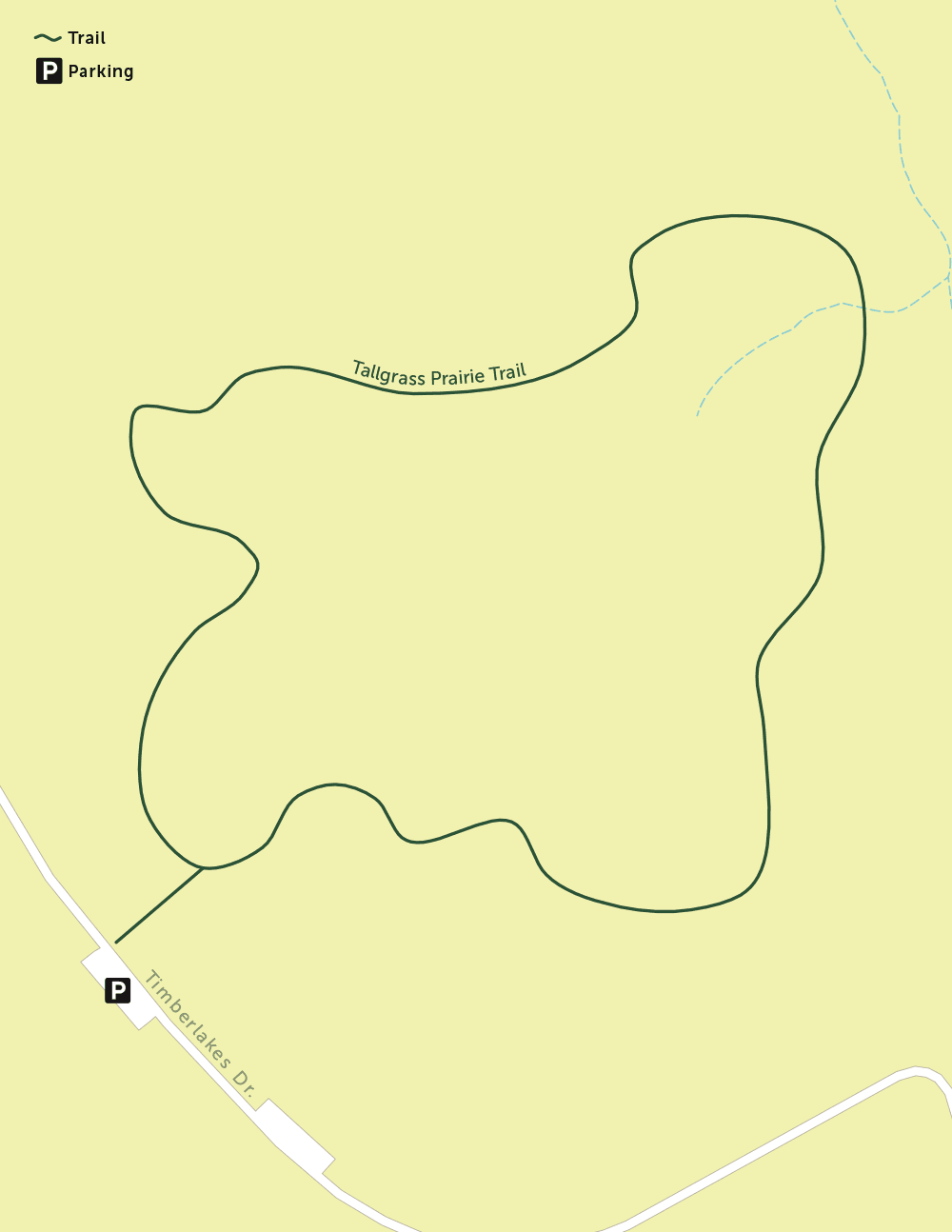
Location – The general address for the park is 9001 Mt Hope Rd, Harrison, OH 45030. There were no directional signs to the trailhead, which is on Timberlakes Drive, but there is a sign at the trailhead.
Parking – asphalt lot for about 10 cars.
Facilities –at multiple sites in the park, but none directly near the trailhead.
Trail Conditions – 0.6 miles and easy grade overall. Bare dirt through the woodlands, and mowed grass in the prairie.
Print Map Link –https://res.cloudinary.com/govimg/image/upload/v1615483891/5a5f7a6b41a5361ef1395dbc/MWF-Tallgrass-Prairie.gif
Benches – some noted along the trail.
Picnic Tables – many elsewhere in the park.
Kids – kids 4 and over should do well.
Dogs – Welcomed on a leash.
Suggested Paired Hikes – There are many other trails in the park. We have enjoyed the Badlands, Oakleaf, and Timberlake Trails at Miami Whitewater and you can find our articles about these hikes at Footpathsblog.com.
Links:https://www.greatparks.org/parks/miami-whitewater-forest
A PRAIRIE TRAIL WALK, CERTAINLY WAS A DIFERENT HIKE FOR ME, VERY ENJOYABLE AND COLORFUL/THANKS
Thanks